
Turned 68 and realized, somewhat abruptly, that getting up from my garden bed had become an actual production — hands on knees, a small grunt I’d have denied making if anyone asked, a moment of genuinely wondering if I needed help. That was the thing that got my attention, more than any number on a scale or a doctor’s chart ever had. Not being able to get up off the ground without ceremony felt like a real line had been crossed.
That garden bed moment is what actually sent me looking into exercises for seniors, something I’d scrolled past for years assuming it was for people much older or much frailer than I felt I was.
I want to say clearly upfront: I’m not a doctor or a physical therapist, and none of this is medical advice. I talked to my own doctor before starting anything here, got cleared, and I’d strongly encourage anyone reading this to do the same before trying any new exercise routine, especially if you have any existing conditions, balance concerns, joint issues, or haven’t exercised in a long time. What follows is just my own experience, and your situation may call for something entirely different, guided by your own doctor or a physical therapist.
Where I Actually Started, Which Was Lower Than I Expected
My doctor, once I got the go-ahead, suggested starting with something a physical therapist friend of my daughter’s later called “embarrassingly easy” exercises, her words, not mine, though she meant it kindly. Chair-assisted movements mostly, things I could do while holding onto something sturdy for balance, nothing that risked a fall.
Felt a little silly at first, honestly, doing what looked like almost nothing. Turned out almost nothing was exactly the right starting point for where I actually was, not where I remembered being twenty years earlier when I could do considerably more without thinking about it.
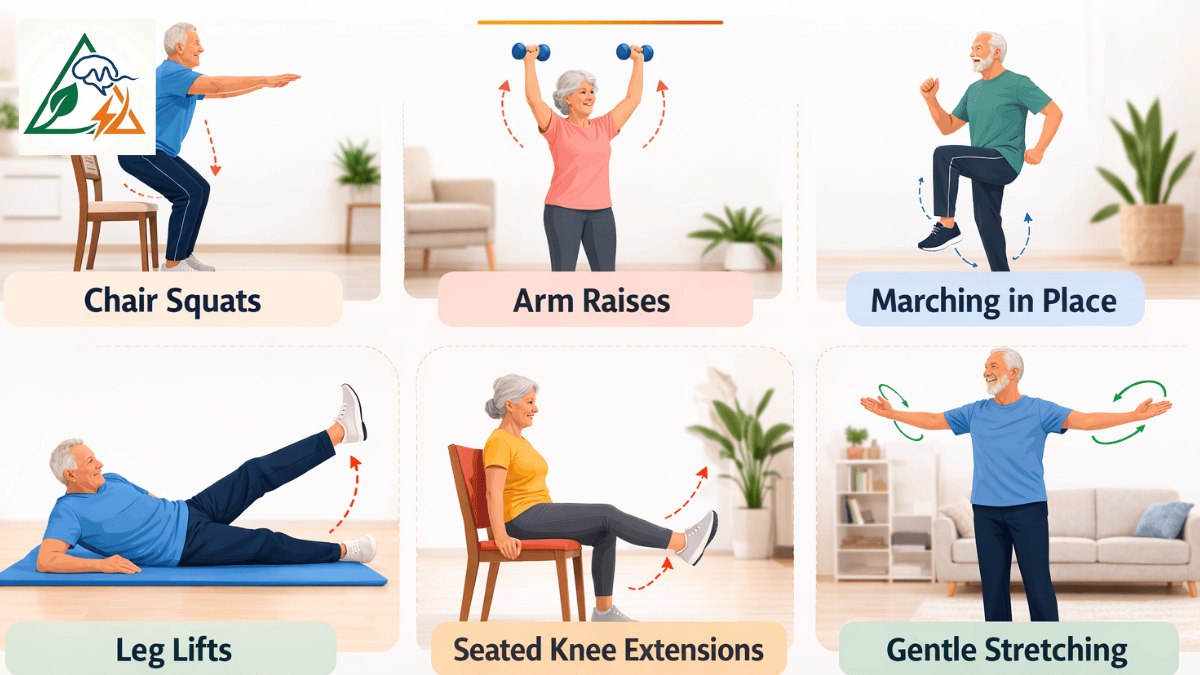
Chair Squats, Which Became My Actual Foundation
Standing in front of a sturdy chair, lowering myself down until I just touched the seat, then standing back up, using my hands on my thighs for extra support in the early weeks. Sounds almost too simple to matter. It mattered plenty.
First week, I could maybe manage five before my legs genuinely shook. Embarrassing, a little, compared to how I used to move. But five was five more than I’d been doing before I started, and that reframe — comparing to my own baseline rather than some younger version of myself — ended up mattering for sticking with this at all.
Wall Push-Ups, Which My Balance Genuinely Needed
Standing arm’s length from a wall, hands flat against it roughly shoulder height, leaning in and pushing back out. Much gentler on shoulders and wrists than floor push-ups, and crucially, no risk of losing my balance and ending up on the ground, which was a real concern my doctor specifically raised given some dizziness I’d occasionally had in the past.
Did these most days, ten or so at a time initially, building slowly. Noticed my arms felt more capable of carrying groceries within a few weeks, a small practical thing but genuinely useful in actual daily life, not just some abstract fitness improvement. Give your muscles time to recover with these practical post-workout habits that can fit into your routine.
Seated Marching, Which Felt Almost Too Easy At First
Sitting in a sturdy chair, lifting one knee at a time like marching in place while seated, arms moving naturally along with it. Genuinely felt silly doing this the first few times, like I was play-acting exercise rather than actually doing it.
My daughter’s physical therapist friend explained this was actually working my hip flexors and core in a way that mattered a great deal for the kind of everyday movement — getting out of a car, climbing stairs — that had started feeling harder without me quite noticing when it began. Kept at it despite feeling silly, and within a few weeks getting out of my car felt noticeably less like a negotiation.
Heel and Toe Raises, Holding Onto the Counter
Standing at my kitchen counter, holding on with both hands for balance, rising up onto my toes and back down, then rocking back onto my heels with toes lifted. Simple, safe, done while holding onto something sturdy the entire time, which mattered given my balance concerns.
This one surprised me the most in terms of actual impact. My ankles had gotten stiffer than I’d realized, and these small movements seemed to loosen something that had quietly tightened up over years of just not moving that particular way anymore.
Standing Balance, Done Very Carefully
This is the one exercise I want to be most careful describing, because balance work carries real fall risk for someone my age, and I only did this with a sturdy chair or counter right there to hold if needed, never freestanding in open space, and only after my doctor confirmed it was appropriate for my specific situation.
Standing near the counter, lightly touching it with fingertips rather than gripping, holding for a few seconds, then a bit longer as weeks passed. Never pushed this one hard or tried to look impressive with it. The point wasn’t testing my limits; it was slowly, cautiously rebuilding something that had quietly eroded.
The Week I Overdid It and Paid For It
About a month in, feeling good about my progress, I added an extra set to everything on the same day, ignoring what was clearly my body telling me was too much too fast. Ended up with a genuinely sore lower back for the better part of a week, scared enough that I called my doctor’s office just to make sure I hadn’t actually hurt something.
Turned out to be ordinary overuse soreness, nothing serious, but it was a real lesson about not treating enthusiasm as a substitute for actual pacing. Went back to my original amounts afterward and built back up more slowly and deliberately than I had the first time.
What My Grandson Said, Which I Think About Often
He’s ten, visited during this whole process, and at one point watched me doing my chair squats and asked, with the blunt honesty only a ten-year-old has, whether I was “doing exercises like Grandpa” — his other grandfather, apparently, does something similar. I laughed, said yes, more or less. He seemed satisfied with that answer and went back to whatever he was doing on his tablet.
Small moment, but it stuck with me, this idea that what I was doing wasn’t some special senior-specific novelty, just ordinary movement that mattered at every age, adapted sensibly for where my body actually was right now. Get started with fitness at home using this simple seven-day workout plan for beginners.
What Actually Changed, Realistically
Getting up off the ground, the original thing that started all this, got noticeably easier within about two months. Not effortless — I’m 68, not twenty-eight, but noticeably less of a production than it had been.
Groceries got easier to carry. Stairs felt less like an event. That garden bed situation that started this whole thing — genuinely better, though I’ll admit I still take my time getting up, just with considerably less grunting involved now.
Modified Planks, Done Against the Counter Instead of the Floor
Floor planks were completely off the table for me, both because getting down to the floor safely was its own challenge and because my wrists genuinely couldn’t handle that kind of weight-bearing anymore. Found a counter-height version instead — hands on the edge of the kitchen counter, body angled, holding a straight line for a short count.
Started at maybe eight seconds, which felt almost laughably brief compared to what I remembered being able to do decades ago. Built up slowly, week by week, without any pressure to reach some impressive number. By two months in, I could hold it closer to thirty seconds, which felt like real, measurable progress even though I’m sure it would look unremarkable to someone younger and more able-bodied.
Sit-to-Stands, Which My Physical Therapist Friend Insisted Mattered Most
My daughter’s physical therapist friend, once she heard about my garden bed incident, specifically flagged sit-to-stand practice as one of the most practically useful exercises for someone my age, more so than almost anything else on this list, because it directly mirrors the exact motion that had become difficult in real life.
Practiced this using a sturdy chair, sitting down slowly with control rather than dropping, then standing back up, focusing on using my legs rather than momentum or my arms pushing off my knees. Awkward and slow at first, genuinely difficult in a way that surprised me given how automatic this motion used to be. Improved steadily, though, and by around week six, I noticed myself doing this in real life — actual chairs, actual moments — with noticeably more control than before I’d started deliberately practicing it.
According to DailyCaring, the sit-to-stand exercise is considered one of the most useful mobility exercises for seniors precisely because it directly strengthens the leg, core, and back muscles used for everyday movements like getting up from a chair or out of bed.
Arm Raises With Light Household Items, Nothing Fancy
Wanted something for my upper body beyond the wall push-ups, and rather than buying actual weights, which felt like an unnecessary expense and also a little intimidating to shop for, I used a couple of canned goods from my pantry. Soup cans, specifically, which are about as unglamorous as exercise equipment gets.
Simple arm raises, out to the sides and up in front, seated in a chair for stability rather than standing, since I didn’t want to risk my balance for something this minor. Helped with everyday things I hadn’t connected to strength before — reaching for items on a higher shelf, for instance, which had started to feel harder without me quite realizing why.
The Days I Genuinely Didn’t Want To Do Any Of This
I want to be honest that motivation wasn’t constant. There were mornings, particularly on colder days when my joints felt stiffer than usual, where the last thing I wanted to do was any of this, and I gave myself permission to skip entirely rather than pushing through discomfort that felt different from ordinary effort.
Learning to tell the difference between “this feels hard because I’m out of practice” and “this feels wrong in a way I should pay attention to” took some time. I erred on the side of caution more than once, skipping a session I probably could have safely done, because I’d rather lose a day of progress than risk pushing through something my body was genuinely trying to warn me about.
What My Wife Noticed Before I Did
She mentioned, maybe six weeks in, that I’d stopped using both hands on the stair railing the way I had been for the past couple of years, something I hadn’t consciously tracked myself. Apparently I’d quietly started using just one hand again, more like how I used to, without either of us specifically working toward that as a goal.
That observation meant more to me than almost anything else that came out of this whole process, honestly, because it wasn’t something I was actively measuring or hoping for. It was just an outside observer noticing an actual, meaningful change in how I moved through my own house.
A Conversation With My Doctor At The Follow-Up
Went back for a routine follow-up about three months into all this, mentioned what I’d been doing, and she seemed genuinely pleased; she said this kind of functional strength work — exercises that mirror real daily movements rather than abstract fitness goals — tends to matter more for people my age than chasing any specific fitness metric. She was clear this wasn’t a substitute for addressing any actual medical issues that come up, just a generally sound approach for someone in reasonably good health looking to maintain function and reduce fall risk.
She also gently reminded me about the overdoing-it week from a couple of months earlier, not scolding exactly, just reinforcing that pacing mattered more than enthusiasm at this stage of life, a point I’d already learned the hard way but appreciated hearing again from someone qualified to say it.
What I’d Tell a Friend Considering Starting This
Talk to your own doctor first, genuinely, not as a formality but as an actual step. My situation, with some occasional dizziness, meant certain exercises needed real caution that might not apply to someone else, and vice versa — someone else might have limitations I don’t have at all.
Start smaller than feels necessary. I felt a little silly at five chair squats and ten wall push-ups, and that feeling was worth pushing through, because starting there instead of somewhere more ambitious is likely what kept me from getting hurt or discouraged early on.
Don’t chase quick results. Two months for noticeable change felt slow in the moment, and I nearly lost patience a few times along the way. Looking back, that timeline feels completely reasonable for what I was actually trying to rebuild.
FAQs
What bodyweight exercises are safest for seniors just starting out? For me, chair-assisted movements — chair squats, wall push-ups, seated marching — felt safest starting out, since they all offered support and minimized fall risk. I’d recommend checking with your own doctor before starting, since your specific situation may call for something different.
How often should seniors do bodyweight exercises? I started with most days but kept sessions short, and learned the hard way that adding too much too quickly, even to gentle exercises, caused real soreness. Slow, gradual increases worked much better for me than enthusiasm-driven jumps.
Are wall push-ups safe for seniors with shoulder issues? They felt gentler on my shoulders than floor push-ups did, but I’d genuinely recommend asking your own doctor or physical therapist about this specifically, since shoulder issues vary a lot from person to person.
Do I need a doctor’s approval before starting a senior exercise routine? I got cleared by my doctor before starting anything, and I’d strongly recommend the same for anyone in a similar position, especially with any existing health conditions or balance concerns.
How long before I notice a difference from these exercises? For me, around two months before daily tasks like getting up off the ground felt noticeably easier. Individual results will vary quite a bit depending on starting point and consistency.
Is balance training risky for seniors? It can carry real fall risk, which is why I only did standing balance work with a sturdy chair or counter right there to hold onto, and only after confirming with my doctor it was appropriate for my situation specifically.
What if I overdo it and get sore? Happened to me about a month in; I added too much too fast and ended up with real soreness for about a week. I’d recommend pacing gradually rather than following my example there, and checking with a doctor if soreness feels like more than ordinary overuse.
What household items can substitute for exercise equipment? I used canned soup from my pantry for light arm raises rather than buying actual weights. Worked fine for my purposes, felt less intimidating than shopping for real equipment, and cost nothing extra.
Is it normal to feel silly doing such gentle exercises at first? Very much so, in my experience. I felt that way starting out, comparing myself to how I used to move decades ago rather than to my actual current baseline. That comparison wasn’t useful, and letting go of it helped me stick with the gentler starting point instead of quitting out of embarrassment.
Conclusion
I didn’t expect getting up from a garden bed to be the thing that started all this, but it was, and I’m genuinely glad it did. What actually helped wasn’t anything dramatic or impressive-looking — chair squats, wall push-ups, careful balance work near the counter, all of it slow and cautious and, if I’m honest, a little embarrassing compared to how I used to move.
But it worked, gradually, and getting my doctor’s input before starting made all the difference in doing this safely rather than guessing on my own. The soreness week taught me pacing mattered more than enthusiasm. My wife noticing the stair railing thing before I did taught me that real change sometimes shows up in small, unmeasured ways rather than the numbers I was tracking on purpose.
If you’re around my age and noticing similar things creeping up on you — a chair that feels harder to rise from, a railing you’re gripping a little tighter than you used to — it might be worth a conversation with your own doctor about where to start. Not about chasing some younger version of yourself. Just about maintaining the ability to move through your own life with a bit more ease than you currently have.
[…] Held that fifteen-second plank from day one for almost forty seconds this time. Noticed it specifically, felt disproportionately proud of a number that would mean nothing to someone who’s been doing this for years, but meant something real to me at that exact point. Explore gentle, equipment-free exercises that can fit easily into a senior-friendly fitness routine. […]